
Laboratory of Geological Processes Simulation (SIMGEO)
The Laboratory of Geological Processes Simulation (SIMGEO) was created in 1995 a joint venture between the Faculty of Earth Sciences of the University of Barcelona (UB) and Geociencias Barcelona (GEO3BCN-CSIC) in the field of experimental and theoretical modelling of geological processes.
The SIMGEO seeks to promote application of experimental and theoretical models to the study of geological processes and, in particular, processes that involve a risk to people and the environment, through funding raised by public and private research projects and contracts and agreements.
The SIMGEO offers researchers a large space and equipment to design and develop experimental models. The SIMGEO has a laboratory of experimental petrology and mineral synthesis, a hydraulic channel 16 m length and a computer lab equipped with the necessary software to develop mathematical models and simulations using geographic information systems
Facilities
- Magma chamber analogue modelling system consists of a pressurisable (up to 6 atm) transparent glass cylinder of 25 cm diameter and 40 cm height, which includes a barometer and a thermocouple, to track temperature and internal pressure tracked during the whole experiment, allows the entrance of different fluids in the same experiment in order to visualise the effect of mixing magmas of diverse types and properties, also allows to inject pressurised gas into the mixture, so we can study the effect of volatiles in the occurring processes, and also can heat the fluids up to around 80º to be able to consider variations in their properties (e.g. density or viscosity) due to temperature changes. Decompression of the tank is controlled by a series of external valve remotely operated, and two high speed digital cameras of high resolution document the experiments allowing internal measurements of fluid structures developing during the experiments such as fountains, drops , etc.
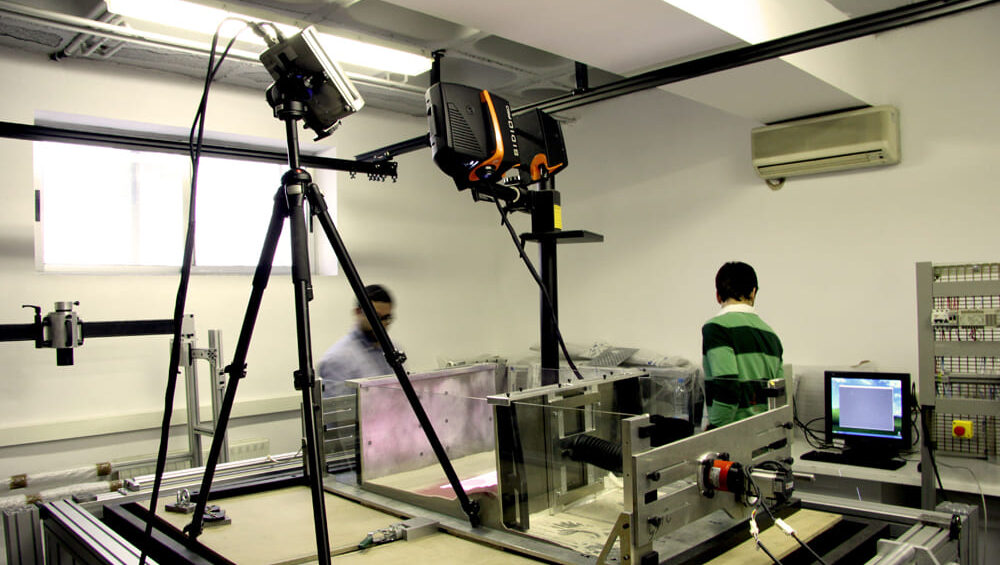
- Analogue structural and tectonic experimental system. Modular modeling table designed to emulate a wide variety of tectonic settings: extension, compression, strike-slip, basement faulting, tectonic inversion, double-wedges, salt tectonics, gravitational glidding, etc… A total of six engines run by a digital controller allow uni, bi or triaxial tests transmitting the deformation to the mechanical arms. The number and configuration of the engines allow modeling any strain field. The rate and orientation of movement are monitored continuously by a computer allowing it to be varied during the experiment. The modeling table also allows to carry out models at different scales, from basin to crustal scale. Digital time-lapsed photographs of the upper surface of the model are taken and controlled by a computer These photographs are complemented by a high-resolution white light scan (SIDIO Pro from Nub3D) which captures the topography of the model during the experiment run, recording changes in topography at millimeter scale.
For more information contact: Adelina Geyer